Background
I grew up as the daughter of a Shan father and a Mon mother who were both educated in Yangon University and then London University during the British colonial period. Their articles and scholarly works (in English) show that despite their fluency in the English language and familiarity with English culture, my mother and father took great pride in our own culture and history.
Passages in my mother’s book “Burmese Family” show that during her schooldays at St. John’s Convent (the best school her parents could send her to in colonial British days), there were strong pressures to make her lose her culture and traditions. During the years of the Saya San rebellion, a major nationalist movement, my mother wrote about how she and her schoolfriend Grace Nee, although still in their early teens, had identified with the sense of nationalism and patriotic pride that the news of Saya San had stirred within them. 1
My father, too, in the opening sections of his book “The Shan States and the British Annexation” wrote about the Shan princes in the resistance against the British annexation of the Shan States after the fall of King Thibaw. My father also wrote about the three Shan princes who successfully repelled the second Mongol invasion of Myanmar, which was staged by China, then ruled by the Yuan Dynasty. 2 My father, being of the Kengtung royal family and schooled early in the monastic traditions of the Shans and Thais, always required us to observe all the traditional gestures of respect towards our elders, now lost among many so-called westernized families. In the post-war period, my father declined an offer from U Nu’s government to join the newly formed diplomatic service of our country. Instead, as Chief Education Officer for the Shan State and Kayah State, he expanded the basic education system and led the reform of the existing Shan script. Perhaps it is not a coincidence that it was his great-grandfather (and my great-great-grandfather), Prince Sao Maha Hkanan, ruler of Kengtung State (1781—1857), who reformed the ancient Yun script used at the time to give the Kengtung Shans the beautiful Tai-Khun script of today, which they are justly proud of.
Together with such nationalist sentiments and traditionalist characteristics, my parents were also broadminded: an English friend of my father called my father a true “Renaissance man”. My mother, too, was no less a “Renaissance woman.” Both my parents excelled in several educational, cultural, and philanthropic pursuits. We had British, American and Australian diplomats who came to visit my parents and see my mother’s school in Taunggyi. We also had Russian doctors and surgeons from Sao San Tun Hospital whom my mother took under her wing and invited to her lavish gatherings. When I went to Cambridge University in England for my doctorate degree, my parents’ British friends were like family to me. In my United Nations career, I had two mentors who were English, and others who were Turkish, Lebanese-Egyptian, Senegalese and Cameroonian. To all these friends and mentors, I owe a debt of gratitude.
I lay out these details so that readers do not misconstrue what I write as an attack upon the British or American people. Rather, it is a critique of colonialism and the current UK-USA policy towards Myanmar, as well as a critique of western media, especially the BBC-Myanmar language team, who promote a certain political narrative, with scant regard for truth and integrity.
Convoluted logic
During the rule of military governments and up to the present day, the UK and US have persisted in swallowing an ignorant statement from the Myanmar opposition that “Myanmar” is the name given by the military junta, and that therefore, the international community should keep using the name “Burma”, although the United Nations has used the name “Myanmar” since 1989. This myth has continued today, and every time we come across in western media, it is like an affront to Myanmar citizens who know their country’s history and culture.
The American Public Broadcasting Service (PBS) explains the two names as follows :
“For generations, the country was called Burma, after the dominant Burman ethnic group. But in 1989, one year after the ruling junta brutally suppressed a pro-democracy uprising, military leaders suddenly changed its name to Myanmar. By then, Burma was an international pariah, desperate for any way to improve its image. Hoping for a sliver of international legitimacy, it said it was discarding a name handed down from its colonial past and to foster ethnic unity. The old name, officials said, excluded the country’s many ethnic minorities… In the Burmese language, “Myanmar” is simply the more formal version of “Burma.” The country’s name was changed only in English. It was linguistic sleight-of-hand. But few people were fooled. Much of the world showed defiance of the junta by refusing to use the new name.” 3
The PBS helpfully notes that President Biden and Mr. Anthony Blinken pointedly avoided the country’s legal name.
The British Broadcasting Corporation (BBC), covering Hilary Clinton’s visit to Myanmar in 2011, went to great lengths to justify the continued use of “Burma” by the opposition (in the process, negating several centuries of our culture and language), saying in garbled logic,
“In the Burmese language, “Myanmar” is simply the more formal version of “Burma.” The country’s name was changed only in English. It was linguistic sleight-of-hand. But few people were fooled. Much of the world showed defiance of the junta by refusing to use the new name….
The UK’s position is similar. Previous statements by the Foreign Office said: “Burma’s democracy movement prefers the form ‘Burma’ because they do not accept the legitimacy of the unelected military regime to change the official name of the country. Internationally, both names are recognised.” 4
The BBC also said,
Before the trip, State Department spokesman Mark Toner told the news agency Mrs Clinton was “mindful of all the sensitivities” but that US policy believed that “any change of the name of a country should be a decision” for its people.
Unravelling Untruths
The arguments on the name of Myanmar put forth by American and British entities contain untruths that need to be exposed and explained.
A “linguistic sleight of hand”? Those of us born and brought up in Myanmar know that the country’s name had always been “Myanmar” since historical times in our own language, in school textbooks, and in official (which means non-English) documents since independence. This name has nothing to do with any military government. So, how can the declaration of a country’s name in that country’s own official language be a “linguistic sleight of hand”? This is being deliberately offensive, or it is sheer ignorance. This name has never changed since early historical times and throughout successive political regimes, as I explain below.
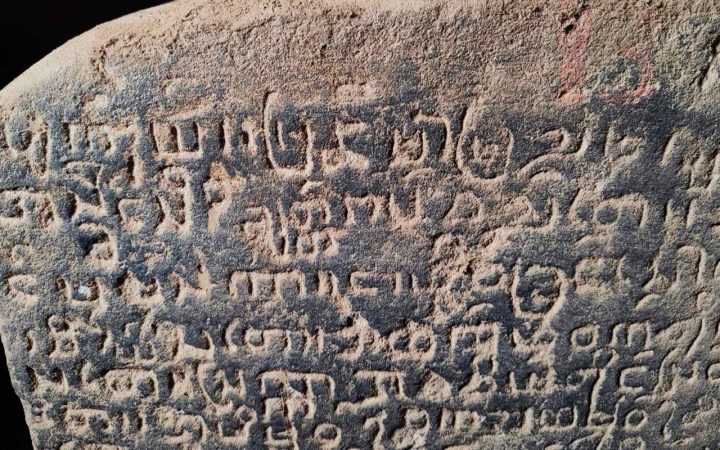
Is a nation not allowed to be proud of its history and culture? Even in ancient times, the inhabitants of the Bagan Empire called their country Myanmar-Pyi or Myanmar Country. The photographs of the Yadanar Kon Htan Inscription stored in the old (1904) museum near the northern entrance of the Ananda Temple are proof of this. Figure 1 is a close-up of the words “Myanmar-Pyi’ carved on the back (Figure 2) of the Yadanar Kon Htan inscription during the Bagan era. It has a date in the Myanmar calendar (597) on the front side of the stone slab, which translates to 1235 AD, according to experts at the Bagan Archaeological Museum. The writing is in the old Myanmar language, which used square letters, as in other ancient stone inscriptions. Nonetheless, educated Myanmar citizens can recognize the words “Myanmar Pyi” (or Myanmar Country) spelt out in the square letters. The museum also has other stone inscriptions that mention the name Myanmar. Clearly, the country has been called “Myanmar Pyi” since the Bagan period in our national language and this is not a name imposed by any military government.
Official language of the country. The official language of the Republic of the Union of Myanmar is Myanmar (as formally written), as reflected in successive laws, the Constitution, official documents, school textbooks, and in the poetry and literature of successive Myanmar kingdoms. The Myanmar language has two forms – the official or formal form and the vernacular (generally spoken) form. The difference between the two is quite marked for some words.5 The name of the country in the formal language has always been written and pronounced “Myanmar,” in ancient stone inscriptions, in laws, books and the Constitution. In other words, the name “Burma” and “Burmese” as pronounced by the British do not exist in our own language and history. Rather, these are names given by the British when Myanmar became a British colony.
British mispronunciations. The word “Myanmar” is pronounced “Mia-mah,” with the first syllable not stressed and pronounced as a very short sound. The colloquial word for Myanmar is “Bamar” in the spoken form. Again, the pronunciation is very short on the first syllable, and the word comes out sounding like “ B’Mah”. The British colonialists interpreted this sound as “Bur-mah” and later, from Burmah (as in the Burmah Oil Company6) it became “Burma”. In enunciating our country’s name, English speakers (including Myanmar nationals using English) have unfortunately called it “Bur-Mer” in an English accent, with equal emphasis on both syllables. Such a word called “Bur-Mer”, and the related (invented) “Burmese” do not exist in our language. So, it is highly ignorant to say that (a) Myanmar is a new name given by the military, (b) our citizens accept the old name of “Burma” more. The majority of citizens in Myanmar use their mother tongue in everyday conversation and will not call their country “Burma”, nor call themselves “Burmese” as they are not speaking English. In fact, they will say, “B’mah Pyi”. Thus, the main reason for Myanmar’s submission to the UN on the name change 7 was that the country’s name should no longer be represented in English documents by a name given by the British colonialists, which had hitherto been non-existent.
Post-truth politics: inequitable treatment for Myanmar. Countries other than Myanmar have also changed country and place names for their own reasons. Mumbai dropped the colonial name “Bombay” while Chennai has changed from Madras. Ceylon is now Sri Lanka. Siam became Thailand in 1939 and again in 1949. In 2022, Turkey has announced that Turkiye (its real Turkish name) will be used. The list goes on: Holland to Netherlands, Southern Rhodesia to Zimbabwe, and so on. The UK and US have never raised objections to such name changes elsewhere. The unfairness of it all.
A decision for the people? The US government spokesman during Mrs. Clinton’s visit remarked, US policy believes that “any change of the name of a country should be a decision” for its people. Since when, may I ask? Has the US asked other countries to undergo referendums to vote on their countries’ names? What about the United States of America itself?
I do not think that the states in Latin America were ever consulted on the use of the word “America,” named after Amerigo Vespucci and used by Martin Waldseemüller in his 1507 map of the New World, which included the present-day South American states.
Language of the majority. It is true that Bamar is the language of the majority in the Republic of the Union of Myanmar. Due to political sensitivities, the census in 2014 and intercensal survey in 2019 were unable to publish the proportions of each of the indigenous National races (Taingyintha) 8 population. An estimate, based on previous censuses, 9 is that well over half the total population speak the Bamar language as their mother tongue, while over two-thirds of the population can speak and understand this language as a first or second language. Common sense indicates the impossibility of reflecting ethnic composition fairly in any country’s name. A country’s name is shaped by history and tradition, as well as by politics. There are many examples of countries that are home to several ethnic groups, but have adopted the name of the majority ethnic group, at least in English documents. For example, English speakers accept the name Thailand, where Thai speakers predominate over other ethnic groups, and similarly, the Lao People’s Democratic Republic, derived from Lao speakers (Lao-Tai) who are more populous than others such as Mon-Khmer, Hmong-Mien, and Chinese-Tibetan.10 Other examples in English language documents at the United Nations are Malaysia (which most agree is derived from Malay, the dominant ethnic group), Uzbekistan (“Place of the Uzbeks”), Kyrgyz Republic, Kazakhstan, and so on, each derived from words representing majority ethnic groups.
Epilogue. Whatever political system prevails in a country, that country surely has the right to move away from the trappings of colonialism and the butchered forms of its language, without being ridiculed by the West. I am an advocate for our culture, rich ethnic languages, arts and traditions. I do not see the name change in political terms. I see it in terms of having dignity and national pride. Sensitivity to such issues, which should transcend politics, would go a long way in reversing the United States’ decline in soft power globally. I leave the reader with what Sayagyi U Hpo Kyaw Myint, our esteemed Myanmar language professor, taught us when I was a young freshman at Yangon University. 11
The Bamar language has so many pronouns. Tens and tens of first person pronouns and second person pronouns, each reflecting socio-economic and religious status, age, familiarity and so on. Then, we even use third person pronouns (“Thu-Myah”) as a substitute for the speaker’s first person pronoun. Such nuances are fully understood only by native Myanmar speakers.
Acknowledgements: I am grateful to Ma Thanegi, writer, artist, and friend, who first called my attention to the existence oi the Yadanar Kon Htan Inscription in Bagan. The photographs and information from the Bagan Archaeological Museum are gratefully acknowledged.
References and notes:
1. Mi Mi Khaing. 1956, 1962. Burmese Family. First edition: London: Orient Longmans. Second edition. Bloomington: Indiana University Press.
2. Sao Saimong Mangrai. 1965. The Shan States and the British Annexation. Ithaca: Cornell University.
3. Public Broadcasting Service (PBS). 2021. Myanmar, Burma and why the different names matter. February 3, 2021.
4. British Broadcasting Corporation (BBC). 2011. ‘Who, What, Why: Should it be Burma or Myanmar?’ https://www.bbc.com/news/magazine-16000467
5. Myanmar people are not alone in this respect: Indonesians, too, have the official form of their language, called “Bahasa resmi”, for communicating with government officials, and informal language such as “Bahasa gaul” or Bahasa Pergaulan (slang), and “Bahasa jalanan” (street language).
6. The Burmah Oil Company Archive. University of Warwick. http://archiveshub.jisc.ac.uk/data/gb1566-bc
7. United Nations. https://www.un.org/en/about-us/member-states/myanmar
8. The term “Taingyintha” in the Myanmar language is officially translated as “National races” (the different ethno-linguistic groups) in the 2008 Constitution of the Republic of the Union of Myanmar.
9. The 1973 and 1983 censuses showed that the race “Burmese” accounted respectively for 68% and 69% of the Union’s total population.
10. Lao Statistics Bureau. 2015. Results of Population and Housing Census 2015. Vientiane: LSB.
11. Myanmar pronouns have evolved over several centuries and are not associated in any way with the gender and pronoun debate in the “Woke” culture wars on US campuses today.