By Hu Wo (Cuckoo’s Song)
Figuratively speaking, emotions look like rippling water waves very often. Usually, they come and go in the mind of a person, especially very quickly. Emotions can be gentle in the sense of a person like a light breeze but sometimes like a violent storm. Just because of this, emotional control has become the key element almost everywhere, especially for lifelong success. Nowadays, the lives of most famous persons have gone to the dogs through lack of emotional management. As one out of human beings, teachers had better have emotional control over themselves, seniors, colleagues, parents, children, school subjects and the school environment. In the main, teachers must maintain emotional management of their students for the simple reason that their emotions can make or break student learning quite easily.
Emotion is a strong mental activity or feeling of which people may lose control, and then it can explode outside like a nuclear bomb. There should be found two main types of emotion: positive and negative. Love, happiness and rapture are included in the types of positive emotion, while hatred, sorrow and fear are involved in the types of negative emotion. In actual fact, any emotion will be no good thing when we feel the emotion more than we should; for instance, exam nerves or test anxiety may be a driving force for a student’s academic achievement, but on the other hand, this emotion may make the student do badly in the exam.
Most teachers tend to have such positive emotions as love, good nature, goodwill, optimism and even test anxiety about their students. Some teachers love young children, so they agree to become nursery or primary assistant teachers. But some teachers like to love adolescent students, so they teach in junior or senior assistant teacher roles. However, many teachers are much given to loving their students as if they were their own sons and daughters. Like biological children, teachers look after their students as though they were their very parents and can put up with their misbehaviour as often as possible. In this way, schoolchildren feel the parental warmth of their teachers and get to know that the school learning environment is as safe as in their homes. Strangely enough, test anxiety is a very common emotion among teachers, like students. Nevertheless, the test anxiety of teachers is not the same as that of students at all. The majority of teachers wish their students to do well in the exam, actually. It is feared that the students may not have passed the exam with flying colours or may have failed the exam like a bull in a china shop. Not only that, but also for them, waiting for exam results is a time of great anxiety. Hence, they almost always draw the unit plan and lesson plan carefully, teach their students hard, prepare sample questions and sometimes even show their suggested potential questions or frequently asked questions so that these tasks will do some good in exams. In such a way, teachers’ emotions often lead to positivity that can enhance student learning.
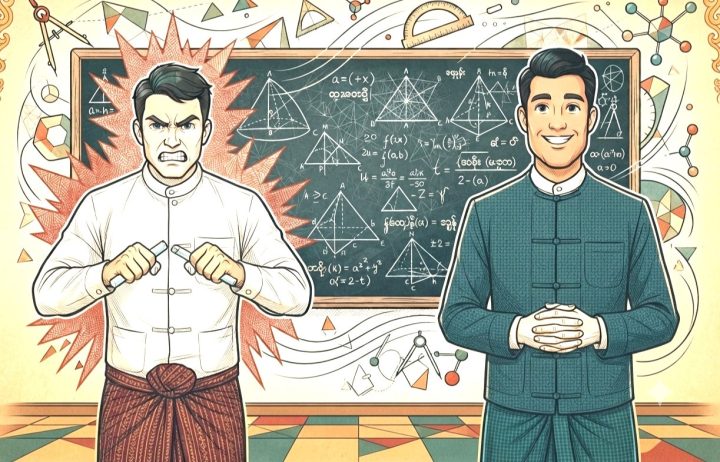
On the other hand, teachers have negative emotions like anger, impatience, doubt, fear and stress. Sometimes students behave badly towards teachers, whether they recognize it or not. Students go to school, not having studied or done any homework, even though teachers give it to them for certain. They can chat in class without being allowed to do so. Sometimes, they even talk back to their teachers. Such students’ misbehaviour mostly contributes to teachers’ anger. It would be worse if a teacher cannot put up with it. This anger will be the greatest obstacle to student learning in the future. And some teachers themselves are impatient with a teaching career or teaching certain school subjects. That may be why this career is not their passion, or these school subjects are not their specialized majors at university. Not only that, some teachers are under the illusion that students will be unable to conduct a number of school studies, such as solving mathematical problems or performing laboratory experiments in science. Similarly, teachers fear to give students more worthy marks than average in checking subjective questions. Worst of all, teachers are possibly overly anxious about student achievement in examinations, and they do teach for several hours on end just in one period of instruction without considering their teaching pace and student learning rate. At that time, teachers’ emotions cause the negativity that steadily worsens student learning.
Of course, teachers should have had physical readiness, mental readiness and emotional readiness even before class. In my teaching experience, some married teachers occasionally bring their personal cases or domestic affairs to the classroom. This manner can have a bad influence on the teaching-learning process. In such a time, teachers tend to lavish their temper upon students as if it were all their fault. Thus, emotional control as well as financial management becomes one of the most essential skills for a person’s life improvement today. Above all, teachers’ emotions can make or break student learning for sure.