By Junior Thin
On the full moon of Tazaungmone, teams work through the night to weave a Buddhist robe and present it before sunrise – a tradition shaped by devotion, skill and shared effort.
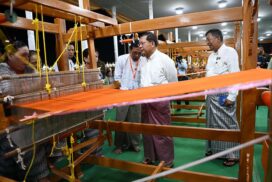
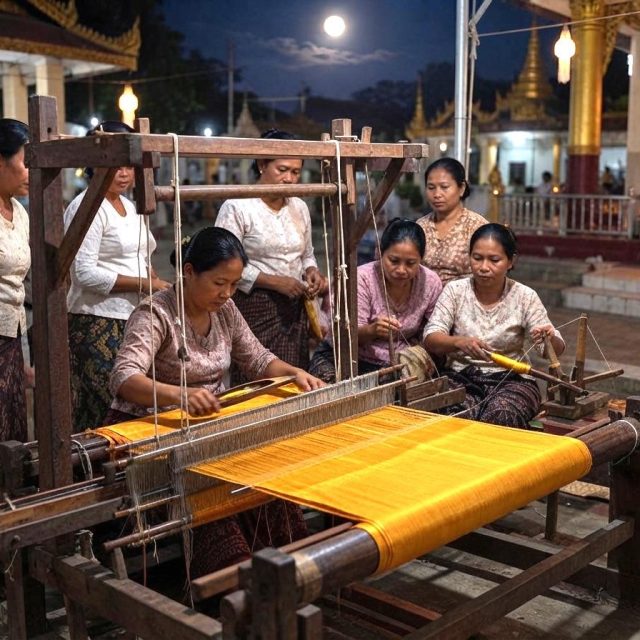
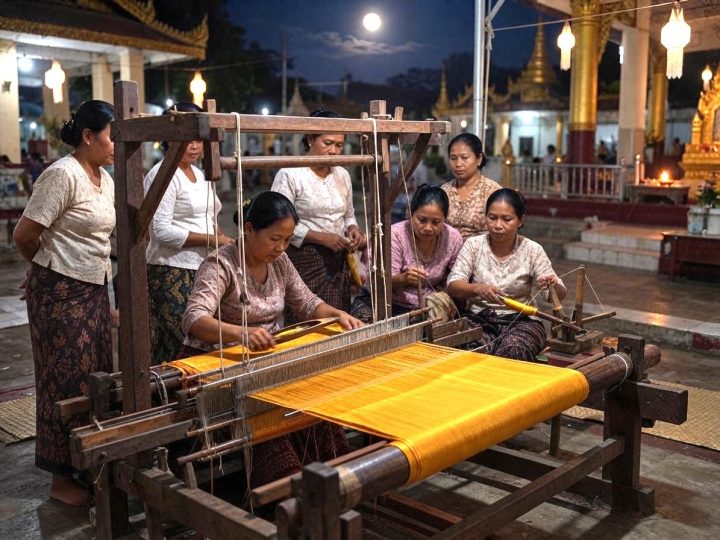
As evening settles over Myanmar on the eve of the Tazaungmone full moon, the sound of looms begins to travel through pagoda precincts. Under lights strung across courtyards, teams take their places at traditional wooden frames. Thread is drawn, the shuttle passes back and forth, and the work continues into the small hours. Their goal is not simply to make a robe. It is to finish it in time to offer it to the Buddha at dawn.
The garment is known as Mathoe Thingan, often literally translated as the “unspoiled” or “non-stale” robe. The name points to the ceremony’s defining rule: the robe is woven and completed during the night, then offered without delay before sunrise on the full-moon day. In Myanmar, the occasion is one of the most distinctive religious observances of Tazaungmone, the eighth month of the traditional lunar calendar.
For readers unfamiliar with Myanmar’s Buddhist calendar, Tazaungmone falls near the transition from the rainy season to the cooler months. Its full moon is also associated with Tazaungdine, the Festival of Lights, when pagodas and communities mark the season with religious offerings and festivities. The robe-weaving ceremony belongs to that larger calendar, but its focus is unusually concentrated: one night, one garment, and a deadline set by daybreak.
For many Myanmar Buddhists, the point is not the garment’s price or the scale of the spectacle. Giving, or dāna, is a central Buddhist practice, and a robe is a practical offering associated with the monastic life. In the Mathoe ceremony, a garment made collectively and presented at daybreak gives that act a distinctly local form. People may contribute time, materials or organization, while others come to pay respect. Visitors may see a contest, with teams and prizes, but the competition takes place within a religious observance: skill is displayed in service of an offering. This blend of worship and participation helps explain why the night can feel both solemn and festive.
In some competitions, the work begins with raw cotton. Participants spin it into thread, prepare the loom, weave the cloth and sew it into a robe before morning. The sequence turns a familiar act of giving into a public demonstration of craft. Teams must divide tasks and keep pace together; one person’s work depends on the next. The contest may reward design and workmanship, but the larger purpose is devotional rather than commercial. The visitor can see the collaborative process as spinning, weaving and sewing a robe from cotton before dawn.
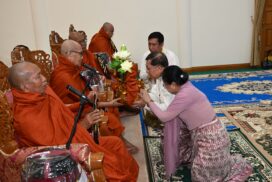
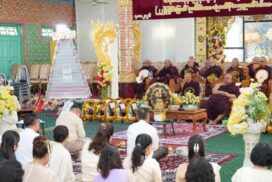
When the robe is finished, it is carried to a Buddha image for offering. In Mandalay, the ceremony at Mahamuni Pagoda has drawn crowds of pilgrims, including visitors who came specifically to witness the early-morning presentation. Some TV channels reported that the robes are called “non-perishable” because they are not meant to grow stale: they are woven within the night and donated as soon as they are complete. The ceremony is therefore both an offering and a moment of public worship, bringing devotees together in the quiet hours before sunrise.
The timing gives the event its particular drama. A robe made over many days could still be valuable, but it would not embody the same act of collective urgency. Here, the deadline asks participants to bring patience, concentration and cooperation to a task that must be completed together. For the faithful, the work itself becomes part of the offering: devotion is expressed not only in the finished garment but in the effort invested in making it.
The ceremony takes place during the season of Kathina, another major period of robe-giving in Theravada Buddhist communities. Kathina offerings are made to the monastic community after the rains retreat. Mathoe Thingan is often described as echoing or imitating that robe-offering tradition, but the ceremonies are not identical. In the Mathoe event, the newly woven robe is commonly presented to a Buddha image; Kathina robes are offered to monks. The distinction helps explain why the night weaving has its own place in Myanmar’s religious calendar, even as it shares the wider season’s emphasis on generosity.
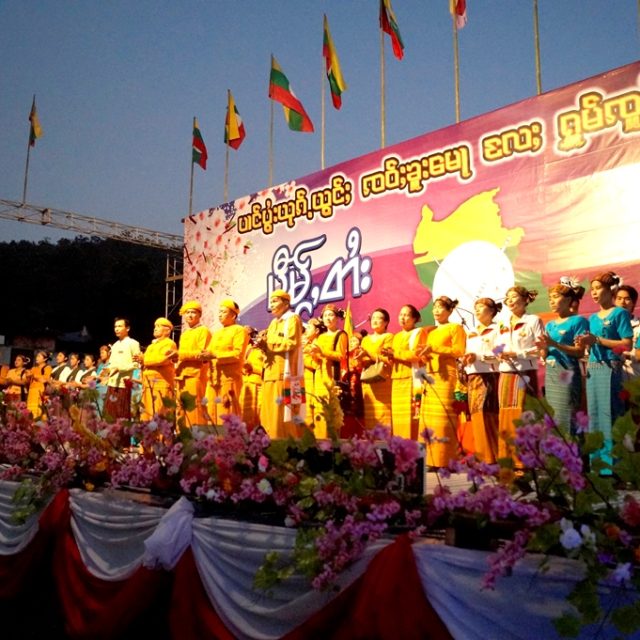
The event is also a living showcase of traditional textile skills. Across Myanmar, pagodas host weaving ceremonies and competitions, with the number of looms and the format varying from place to place. At Yangon’s Shwedagon Pagoda and other sites, teams weave robes for presentation at dawn on the full moon. The atmosphere can include music, announcements and spectators watching the work unfold. Yet the essential sequence remains simple: begin at night, finish before daybreak, and offer the robe as soon as it is ready.
One point can be confusing to visitors: Mathoe Thingan does not necessarily mean a robe made from lotus fibre. Some ceremonies feature robes called “golden lotus robes,” and lotus-thread weaving is a celebrated craft in its own right. But extracting fibre from lotus stems and turning it into thread is a separate, time-consuming process. A cultural account of lotus robes from Inlay Lake describes the work as taking far longer than a single night. The defining feature of Mathoe Thingan is the overnight completion and dawn offering, not a particular plant fibre.
By the time the first light reaches the pagoda, the night’s work has become a public act of giving. The robe may be small beside the gilded Buddha image before which it is offered, but its meaning lies in the hours and hands behind it. For participants, the ceremony joins faith with a practical skill; for onlookers, it offers a rare view of textile making as a shared religious observance. And for Myanmar’s communities, the robe completed before dawn carries a simple message: generosity is not only something given, but something people can make together.