By Khin Maung Myint
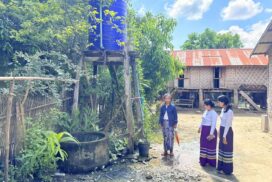
From the days of my childhood in the 1930s to my nineties today, one enduring image from central Myanmar has remained etched in my memory. During the height of the dry season, when the rains have long vanished, and the village ponds have cracked into baked clay, villagers walk out onto the glaring white sandbanks of dried-up creeks and riverbeds. Under a punishing sun, with patient, backbreaking labour, they dig shallow pits – Let-yet-twin – by hand, waiting for precious subsurface water to slowly seep into the hollow pit so they can scoop it up, pot by pot, for themselves, their children, and their livestock.
For nine decades, I have watched empires fall, borders shift, and modern technology transform the world. Yet in the heartland of Myanmar, the daily struggle for a single pot of clean water has remained stubbornly unchanged. That people in Myanmar’s Dry Zone (Anya) – across Magway, Mandalay, and lower Sagaing – are still forced to spend hours of their lives extracting drinking water from dry sandbars in the twenty-first century is not a misfortune, but a chronic gap in rural water infrastructure that can be resolved.
Myanmar is a country richly endowed by nature. Great river systems – the Ayeyawady, the Chindwin, the Thanlwin, and the Sittoung – along with countless tributaries and mountain streams, carry immense volumes of fresh water down from the northern highlands and across the central plains before emptying into the Andaman Sea and the Bay of Bengal. Yet every year, hundreds of billions of cubic meters of life-giving water flow unused into the ocean while communities living just miles from these great waterways suffer acute shortages for human consumption, livestock, and agriculture.
During the monsoon, rivers swell and flood surrounding lowlands; six months later, those same communities are parched. The tragedy of the Dry Zone has never been an absolute lack of water in the nation; rather, it has been the unmet challenge of capturing, storing, treating, and distributing the water that already passes through our land.
The Neighbouring Example: How Thailand Harnesses Its Water
We need not look far to see how a South-East Asian neighbour with a similar monsoon climate solved this very challenge. Since my retirement, I have travelled extensively through the Khorat Plateau – known as Isan – in northeastern Thailand, a region that historically shared many of the same arid, sandy-soiled, monsoon-dependent hardships as central Myanmar. For generations, Isan was defined by erratic rainfall, dry creek beds, and seasonal poverty. Yet over the past several decades, I have witnessed firsthand how rural water security was systematically transformed through coordinated infrastructure and decentralized engineering.
This transformation is deeply personal to my family. My son served as one of the Project Managers on several of these vital construction works, overseeing the building of diversion weirs and irrigation canals in Isan, as well as a major reservoir initiated by the late monarch, King Bhumibol Adulyadej (Rama IX) – one of the two largest dams built in the country at the time. Constructed across the Huai Samong River in Prachinburi Province (the Naruebodindrachinta Reservoir), this vast engineering project was designed with multiple interlocking goals: to store monsoon runoff for dry-season agriculture, to prevent destructive seasonal flooding downstream, and to maintain sufficient freshwater flow to push back against seawater rising far upstream into the Bang Pakong River during the dry months, protecting both municipal drinking supplies and vital agricultural orchards and fields from salinity.
Rather than leaving rural communities at the mercy of seasonal extremes, Thailand invested consistently over decades in a multi-tiered water management network:
• Multi-Purpose Reservoirs and Check Dams: Large Royal-initiated dams like the Huai Samong reservoir – alongside thousands of medium- and small-scale reservoirs, kaem ling (“monkey cheeks” flood-retention basins), and community check dams – were built across rivers and seasonal streams. These structures trap monsoon runoff where it falls, recharge groundwater tables, prevent destructive flash floods, and preserve vital reserves for the dry season.
• Canals and River-Pumping Stations: Extensive lined irrigation canal networks and electric or solar-powered river-pumping stations lift water from major rivers such as the Mekong, Chi, and Mun onto higher agricultural plateaus. By overcoming elevation barriers, Thailand turned single-crop, rain-fed subsistence land into productive, year-round farmland.
• Tube Wells and Village Water Treatment Plants: At the community level, deep, properly cased tube wells tap reliable aquifers, while compact, standardized village water treatment plants clarify, filter, and chlorinate raw surface or groundwater. Today, metered, piped clean water reaches rural households across Thailand’s provinces, freeing villagers from the daily physical toll of hauling water from distant riverbeds and dramatically reducing waterborne disease.
Turning Desert Sand into Farmland: The Israeli Model
If Thailand demonstrates what can be achieved within a neighbouring monsoon basin, Israel offers an even more striking lesson in overcoming extreme aridity. More than half of Israel is true desert, receiving only a fraction of the annual rainfall that falls even in Myanmar’s Dry Zone. Yet through relentless engineering, institutional discipline, and technological innovation, Israel transformed barren desert sand into thriving agricultural land and now produces more freshwater than it consumes.
Central to this transformation is pressurized, precision agriculture – often referred to as forced or pressurized irrigation – combined with total water reclamation and conservation:
• Pressurized Drip Irrigation: In central Myanmar, where water is pumped or diverted onto fields, it is typically distributed through open, unlined earth ditches. Under the scorching Anya sun, up to half of that water is lost to evaporation and deep seepage before it ever reaches a crop. By contrast, pressurized pipe networks deliver measured drops of water and dissolved nutrients (“fertigation”) directly to the root zone of each plant. Pioneered in Israel, this method achieves 90 to 95 per cent water-use efficiency, preventing soil salinization and allowing high-value crops, such as pulses, oilseeds, cotton, and fruits, to flourish even in sandy soils.
• Wastewater Recycling and National Conveyance: Israel treats and recycles roughly 85 to 95 per cent of its municipal wastewater for safe agricultural use, ensuring that water is used twice before returning to the hydrological cycle. Simultaneously, a national water carrier system – backed by large-scale desalination along the coast – moves water from water-surplus regions to the arid Negev desert in the south. Every drop is metered, priced realistically to prevent waste, and managed as a strategic national asset.
A Practical Blueprint for Myanmar’s Heartland
Myanmar does not need to invent any sophisticated technologies, nor does it need to wait for costly, experimental methods. We already possess the great rivers, the reliable seasonal monsoons, and the fertile alluvial plains that desert nations can only dream of. Bridging the gap between our abundant rivers and our thirsty heartland requires a disciplined, four-part strategy:
1. Capture the Monsoon Surge Locally: Construct a dense network of small- and medium-scale retention reservoirs, diversion weirs, and earthen check dams across the seasonal streams feeding into the Ayeyarwady and Chindwin basins. Holding water back in the upper watersheds slows runoff, prevents soil erosion, and naturally recharges the shallow aquifers that dry-zone villages depend on.
2. Lift Water to the Plains: Expand solar- and grid-powered river-pumping stations along the Ayeyawady, Chindwin, and Mu rivers to lift water onto adjacent dry terraces, paired with concrete-lined distribution canals to minimize seepage.
3. Standardize Rural Water Supply: Move beyond emergency drought relief by establishing permanent, standardized village water supply systems, combining deep hydrogeological tube wells and protected surface intakes with simple, locally maintainable filtration and chlorination units, so every household has piped water at the turn of a tap.
4. Modernize Dry-Zone Farming: Introduce subsidized, small-scale pressurized drip and micro-sprinkler kits for Dry Zone farmers, supported by agricultural extension services. Using half the water to grow twice the yield will raise rural incomes while easing pressure on stressed rivers and aquifers.
A Call for Practical Action
As global leaders prepare to gather at the UN Water Conference in Abu Dhabi during December to address the world’s pressing water challenges, Myanmar’s own path forward is clear. Water security is not merely an engineering problem; it is the foundation of human dignity, public health, and rural prosperity. Having lived nearly a century, I have seen how swiftly a nation’s landscape can change when practical wisdom meets determined action. We do not lack water in Myanmar; we lack the infrastructure to keep it where our people live. After ninety years of watching our villagers kneel on glaring white sandbars to dig Let-yet-twin for a drink of water, it is long past time we brought the river to the village.
Author’s Note
This article was born out of nearly a century of lived memory in Myanmar, combined with firsthand field observations and dedicated independent research. Following my retirement, I spent extended periods staying at various water management construction sites across Thailand where my son – a water resources engineer – served as a Project Manager on major reservoir, weir, and irrigation projects. Watching those systems take shape on the ground, alongside years of rigorous online research, showed me how a monsoon nation can conquer seasonal scarcity.
My appreciation for Israel’s water engineering, meanwhile, began decades earlier in the 1990s during my service at the Myanma Posts and Telecommunications (MPT) Corporation. Through casual conversations with an Israeli telecommunications engineer stationed in Yangon during the construction of ten automatic telephone exchanges across district towns, I first learned how his country had turned barren desert sand into thriving farmland through pressurized drip irrigation – a lesson I later explored in depth through independent research. While I write as a concerned elder rather than a water specialist, my hope is that these reflections offer a practical perspective for engineers, policymakers, and fellow citizens working to bring lasting water security to Myanmar’s heartland.