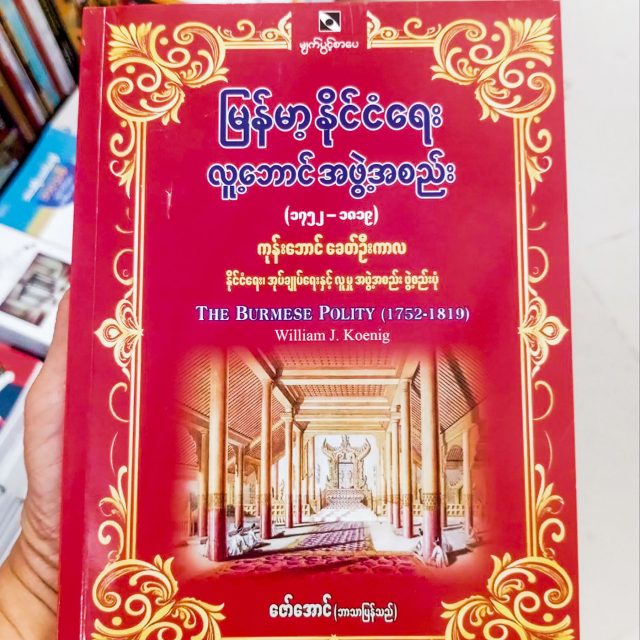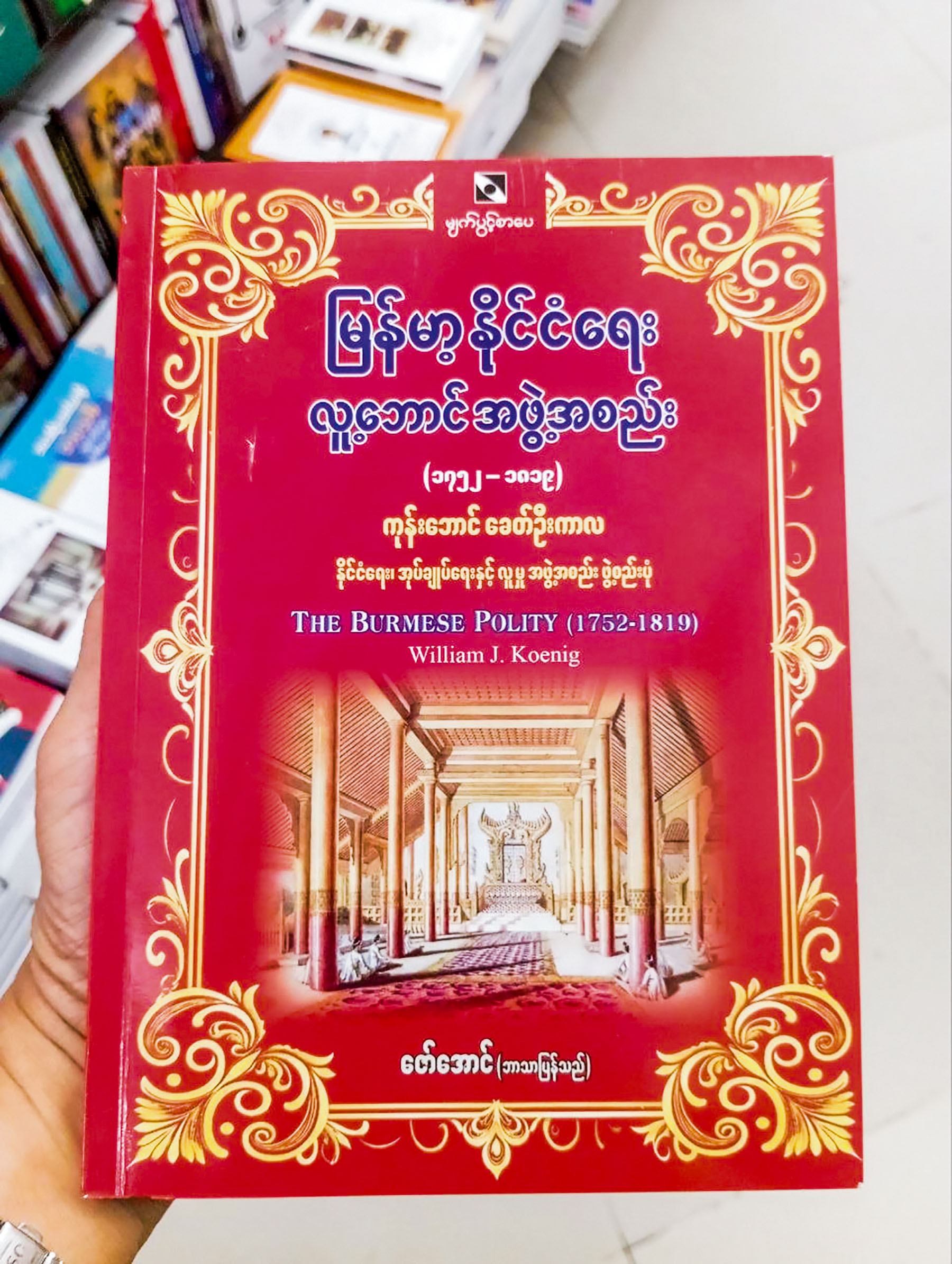
Translator – Zaw Aung
Publishing House – Myat Pwint Sarpay
Publication Date – October 2026
Price – K25,000
Translated by Zaw Aung under the Myanmar title Myanma Naingnganyay Luboung Ahpwe Ahsee (Politics, Administration, and Social Organization in the Early Konbaung Period), this book is a Myanmar translation of The Burmese Polity, 1752-1819: Politics, Administration, and Social Organization in the Early Konbaung Period by William J Koenig.
Originally published in 1990 by the Centre for South and South-East Asian Studies at the University of Michigan, the 332-page volume is an exhaustive scholarly work, analyzing political institutions and social structure of the early Konbaung dynasty (1752-1819). This translation introduces Koenig’s English-language historical research to Myanmar readers, offering deep insight into the political mechanism and social organization of the early Konbaung era.
William J Koenig is a renowned specialist in Myanmar history, particularly the political and administrative institutions of the early Konbaung period. Considered his magnum opus, the book meticulously examines the political processes, administrative mechanisms, and social stratification of that era. In academic circles, it is widely recognized as a foundational reference text for understanding the in-depth mechanisms of pre-colonial Myanmar society.
Focusing on the political and social conditions of the early Konbaung dynasty from 1752 to 1819, the author primarily analyzes the role of Buddhism in shaping the political processes of the Myanmar monarchy. Alongside central and regional administrative institutions, the book examines senior officials, the men and women of the royal court, and mechanisms of political succession. In particular, its exploration of royal succession forms the core of the work, reflecting the primary political preoccupation of the period. This valuable study draws extensively on primary Myanmar sources, including legal treatises and local land revenue records, synthesized with contemporary European accounts.
Reviewing the original work, Choice magazine noted that the book represents “an important addition to the limited body of analytical works on pre-colonial Burmese history,” describing it as an “indispensable” reference for scholars of South-East Asian, and especially Myanmar, history. Comparing this volume with two other works on pre-colonial Myanmar history, Japanese scholar Takahiro Iwaki remarked that Koenig’s methodology effectively integrates socioeconomic background, kingship, political thought, and administrative structure, proving especially rich in its analysis of royal succession.
In his foreword, the translator writes:
“This treatise highlights the early Konbaung period from the rise of King Alaungpaya in 1752 to the passing of King Bodawpaya in 1819. The author defines this 67-year span as ‘the early dynamic phase and the incipient stage of decline of the Konbaung dynasty,’ marking a critical turning point in pre-colonial Myanmar history.”
As a rigorous work of academic research rather than a general historical narrative, this book is best suited for readers who possess background knowledge of Myanmar history and an interest in institutional analysis. Given its scholarly terminology, the translation will be most rewarding for readers already familiar with the fundamentals of Myanmar history.