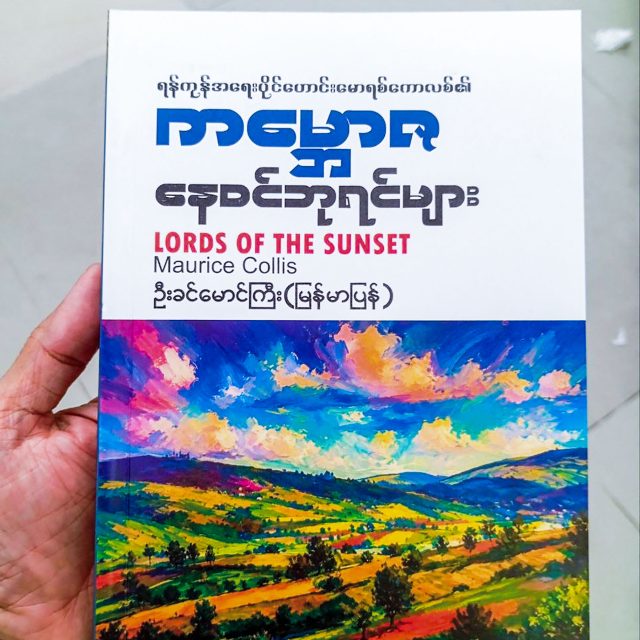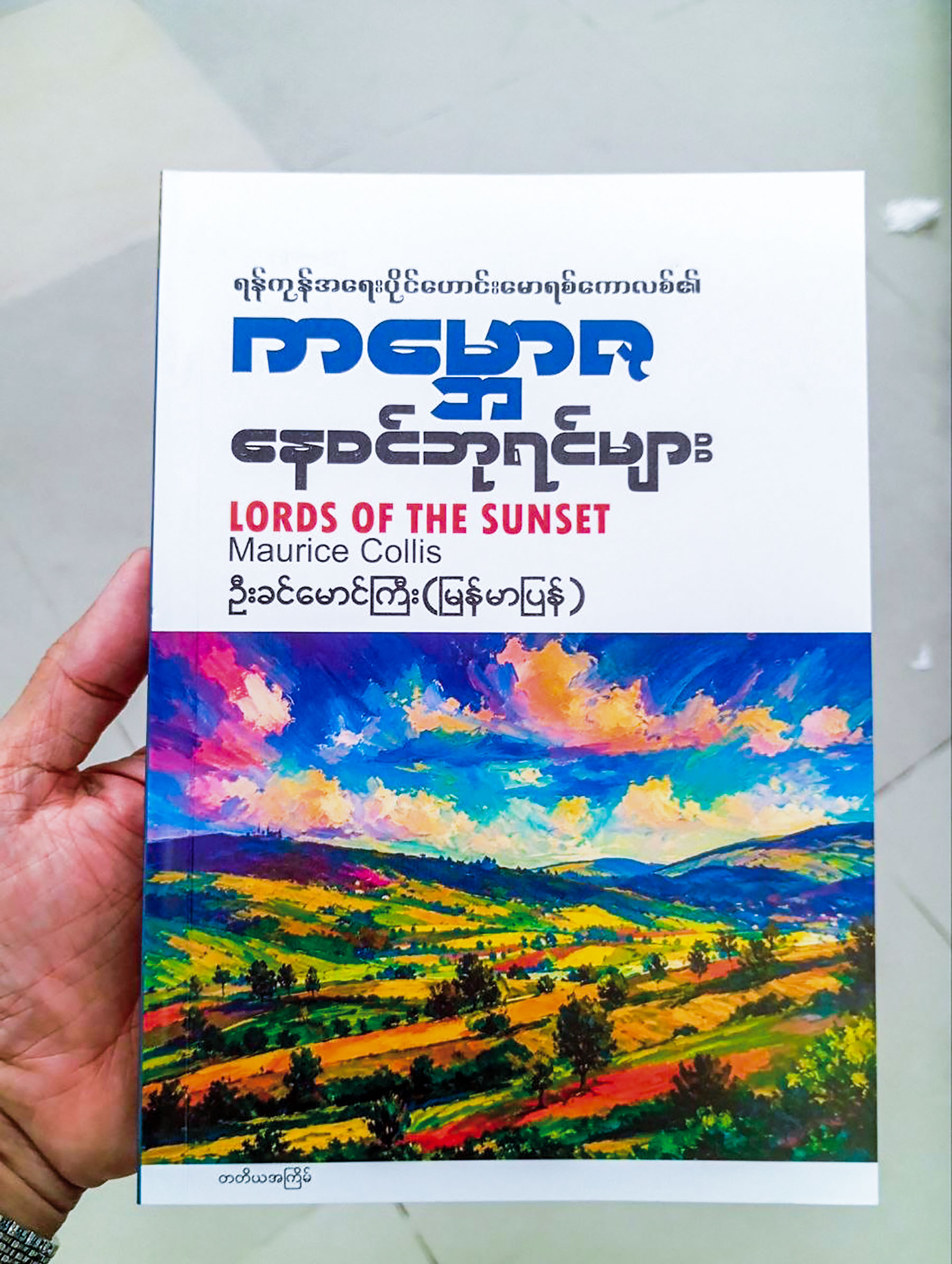
Translator – U Khin Maung Gyi
Publishing House – Seikku Cho Cho
Publication Date – September 2026 (Reprint)
Price – K15,000
Written by Maurice Collis, a former Deputy Commissioner of Rangoon (Yangon), under the original title Lords of the Sunset and translated into Myanmar by U Khin Maung Gyi, Kambawza Naywin Bayinmya (Lords of the Sunset) is a work of travel literature chronicling the twilight years of Shan State during the late colonial era.
The original author, Maurice Collis, was a former member of the Indian Civil Service (ICS) who arrived in Myanmar in 1912, serving as a District Magistrate and judge in Yangon. This experience gave him a profound understanding of Myanmar’s culture and language, which later formed the foundation for his numerous historical books. In 1938, he returned from England to Shan State at the invitation of the then-Governor (Commissioner) of the Federated Shan States, embarking on a journey that inspired this book.
The book presents an eyewitness portrait of social life in late-colonial Shan State. With the special privileges of a British official, Collis travelled deep into the various Sawbwa (Shan hereditary chieftain) states, staying at their palaces and participating in royal festivities. Alongside vivid descriptions of the Shan hills’ natural scenery, the work documents Shan customs, the history and administration of Sawbwa rule, and the extraction of local natural resources—such as silver mines and forests—by British companies. Notably, he portrays an ageing princess who, despite her diminished political status, continued to command the deep respect of both officials and locals through her wisdom and dignity, emerging as a vivid central figure in the narrative.
Collis is a gifted writer capable of recreating the atmosphere of an interior space with just a few words, making readers feel as though they were right there with him. He recounts experiences such as attending the funeral of a Shan Sawbwa and travelling in a vintage truck alongside an elderly princess. As a travelogue and historical memoir, the book captures his encounters with the Shan Sawbwas of the 1930s, documenting their palaces, courts, way of life, and culture. As they read, audiences can envision how a former British official perceived the world of the Shan Sawbwas as it passed through its final chapter under British rule.
It is worth noting that this book is a piece of travel literature rather than a comprehensive historical research text; its primary value lies in the author’s personal experiences and observations rather than a systematic analysis of Shan State’s political and economic structures. Furthermore, having been written in 1938, the original work naturally carries the perspective of a colonial-era Westerner and does not directly record the voices of the local people. Nevertheless, this does not obscure his genuine affection for Shan culture – he spoke Myanmar fluently and forged deep friendships with many local people.
The opening chapter of the book, titled “The Invitation”, begins with the following passage:
“The British Empire was like a vast country house in the possession of an old English family. Generation after generation had altered and added to it. One lord built a new wing and returned from the Grand Tour with pictures; another redecorated the ceilings and collected Greek marbles; his son went to the East and brought back Buddhas and Chinese porcelain. The house became full of heterogeneous objects, some more admired than others.”