In June 2014, the three ancient Pyu cities of Beikthano, Halin, and Sri Ksetra in Myanmar were inscribed as UNESCO World Heritage Sites for their historical and cultural significance.

Religious buildings in the Sri Ksetra Cultural Zone, a World Heritage Site in Pyay Township, Bago Region, will be renovated while preserving their original features, according to U Tun Tun Aye, head of the Department of Archaeology and National Museum (Sri Ksetra Branch).
Cracks appeared in the Bawbawgyi Pagoda and the Lemyethna Pagoda within the zone due to the Mandalay earthquake on 28 March, and the damaged areas will reportedly be repaired without compromising the original structures.
“When the Mandalay earthquake struck, the Sri Ksetra Cultural Zone was also affected. Most of the pagodas here were not very tall and therefore did not sustain serious damage. However, the slightly taller Bawbawgyi Pagoda and the Lemyethna Temple were damaged, as their structures were already weakened. Since they have been damaged, we must take the time to restore them while preserving their originality,” said U Tun Tun Aye.
The Bawbawgyi Pagoda is one of the oldest structures in the ancient Pyu city of Sri Ksetra, while the Lemyethna Temple is another notable example of Pyu architecture. Built around the 6th–7th century AD, the Bawbawgyi Pagoda stands 46.634 metres high and has a circumference of 64.8 metres. Its design features a five-tiered platform topped by a long, cylindrical brick structure. The pagoda is said to resemble the Dhamek Stupa in Sarnath, India, a memorial site where the Buddha delivered the Anattalakkhana Sutta, also known as the Discourse on the Characteristic of Non-self.
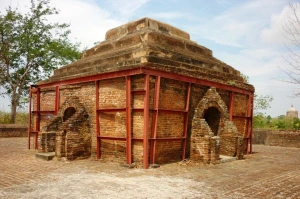
Similarly, the Lemyethna Temple is the only cave pagoda found in the ancient city of Sri Ksetra. This small, square structure features four arches and entrances and is estimated to have been built during the late Pyu period, between the 7th and 9th centuries. The Lemyethna Temple is a significant monument that illustrates the development of cave pagodas in Pyu Buddhist architecture.
Three ancient Pyu cities in Myanmar — Beikthano, Halin, and Sri Ksetra — were designated as World Heritage Sites in June 2014. — ASH/TH