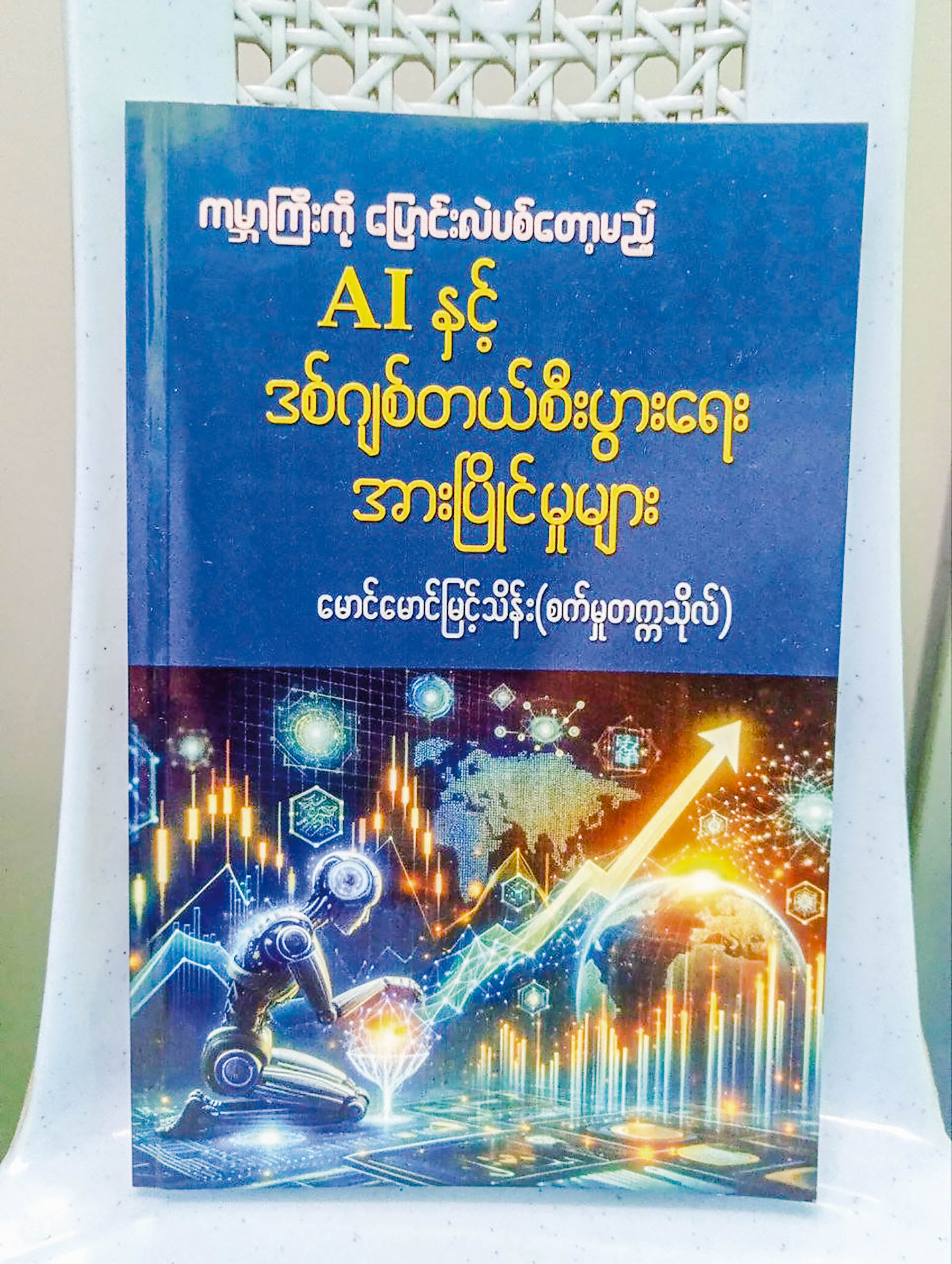
Author – Maung Maung Myint Thein (RIT)
Publishing House – AZ
Publication Date – June 2026 (1st Edition)
Price – K10,000
During Chinese President Xi Jinping’s three-day official visit to the United States from 23 to 25 September, he met President Donald Trump at the White House. Aiming to stabilize bilateral relations, the two leaders focused their discussions on six major agenda topics, among which was the crucial subject of regulations concerning Artificial Intelligence (AI). Both sides reportedly agreed to establish a dedicated communication channel and convene a government-to-government risk management dialogue in the coming November regarding the benefits and risks of advanced AI technologies – referred to by Trump as “Super Intelligence” and framed by China as “AI Dialogue”. This serves as clear evidence of the immense strategic significance AI holds between the two superpowers.
The book introduced to readers this week is:
“In the coming era, while governments around the world navigate the intricate and challenging terrain of AI regulations, their governance models and digital economic regulatory frameworks – though diverse from nation to nation – will inevitably develop alongside intense strategic competition.”
This excerpt comes from the book “AI and the Digital Economy Rivalries Poised to Transform the World”, authored by Maung Maung Myint Thein (RIT).
Within this volume, readers will explore chapters examining whether China’s AI breakthrough signals a new era of technological innovation, the concept of digital empires and the China-EU-US rivalry over tech regulations, the innovation secrets of Japan and South Korea, the global semiconductor supply chain and Indonesia’s strategic initiatives, and whether globalization is coming to an end. Other featured chapters cover practical applications of artificial intelligence, ICT-driven e-government, the global race for AI regulation, India’s digital technology power, the ASEAN Digital Economy Framework Agreement, Japan falling behind in the electric vehicle manufacturing race, the integration of bureaucracy and democracy, strategic convergence between India and the European Union, three perspectives on international relations, what the world can learn from Japan, and why India cannot yet replace China.
The opening chapter, titled “Does China’s AI breakthrough signal a new era of technological innovation?”, begins:
“Amid multilateral discussions at the Munich Security Conference and high-level talks at the Paris Summit, Chinese leaders called for global collaboration on AI safety. Technology companies and investors in China witnessed a volatile yet promising week of AI breakthroughs. Both domestically and internationally, alongside symposiums led by top Chinese tech leaders and President Xi, China’s high-level leadership has demonstrated confidence in AI development while maintaining transparency toward international cooperation.”