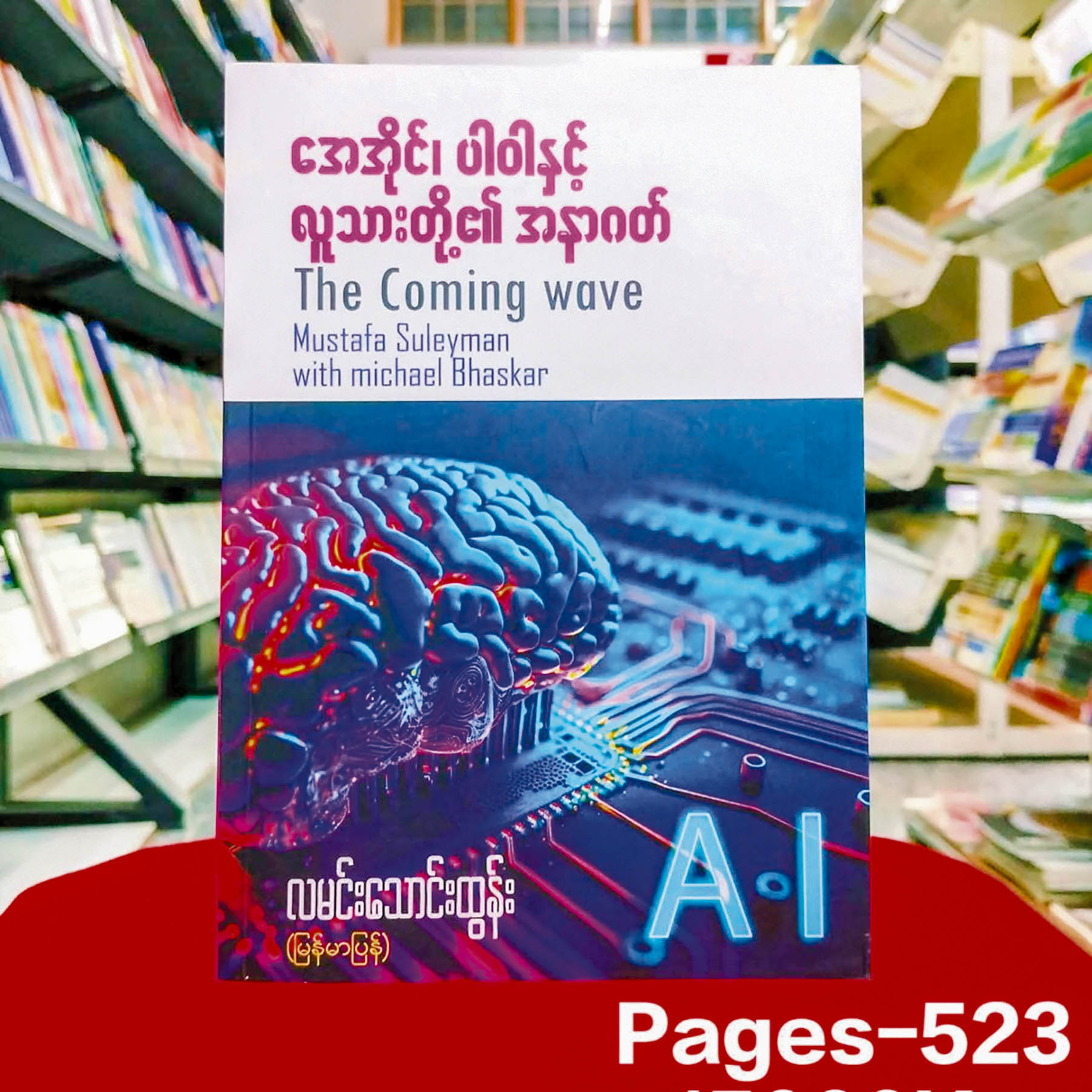
Translator – La Min Thaung Tun
Publishing House – Sar Si Sein
Publication Date – March 2025 (1st Edition)
Price – K15,000
Saya La Min Thaung Tun translated the book The Coming Wave, co-authored by Mustafa Suleyman and Michael Bhaskar, into Myanmar. Mustafa Suleyman is a co-founder of DeepMind and currently serves as CEO of Microsoft AI.
Readers will grasp the author’s concept of The Grand Bargain, suggesting that risks of advanced technology can be mitigated through a tri-party caompromise between state, private cooperation and civil society by relying on three interconnected pillars: international cooperation, technology security engineering, and new governance frameworks. This approach focuses on balancing competing interests to achieve technology containment.
Additionally, the book analyzes the dangers and shifts in power distribution from the insider perspective of a technology creator. Among books discussing artificial intelligence AI, this book stands out because it not only points out problems but also offers high-level security policy and governance, based on the author’s industry experience.
In the book’s “Preface”, the question of how the coming technological wave will affect humanity is addressed from the AI perspective: “There are moments in human history that stand as turning points. At those moments, humanity’s fate hangs in the balance. The discovery of fire, the invention of the wheel, and the harnessing of electricity were moments that transformed human civilization. From those periods onward, the course of history changed forever. And now we are stepping into a rapidly cresting era of unprecedented technological power. We are about to face the next wave, including both advanced AI and biotechnology. We have never encountered technologies with such potential to reshape the world in ways both exhilarating and terrifying.
On one hand, the benefits of these technologies are extraordinarily broad and profound. With AI, we might unlock the secrets of the universe and cure diseases that have baffled us for centuries. We may expand the boundaries of imagination and create new forms of art and culture. With rapidly advancing AI, we can fight disease, improve agriculture, and create a healthier, more sustainable world. But on the other hand, the potential dangers of these technologies carry big risks.
AI helps us create systems beyond our control and find ourselves at the mercy of algorithms we do not understand. Biotechnology allows us to edit the foundational code of life, creating immense potential for innovation alongside significant ecological and ethical risks. As we stand at this turning point, we have to face a choice between a future of unparalleled possibilities and a future of unimaginable catastrophe. Humanity’s fate hangs in the balance. The decisions we make in the coming years and decades will determine whether these technologies lead us towards challenges or make us victims of their dangers.”
Thus, it is worth reading for those who want to systematically understand how AI and biotechnology are reshaping society, and for leaders who need to draft AI governance frameworks for their organizations.